Dalle Khorsani
Capsicum annuum var. cerasiforme — the round red cherry chilli of the eastern Himalaya
— सिक्किम का उपहार —
Grown across the mid-hills of South, West and East Sikkim and the adjoining Darjeeling district, Dalle Khorsani is prized for a pungency and aroma unlike any other chilli in India. Tourists and traders alike have come to know it simply as the Gift of Sikkim.
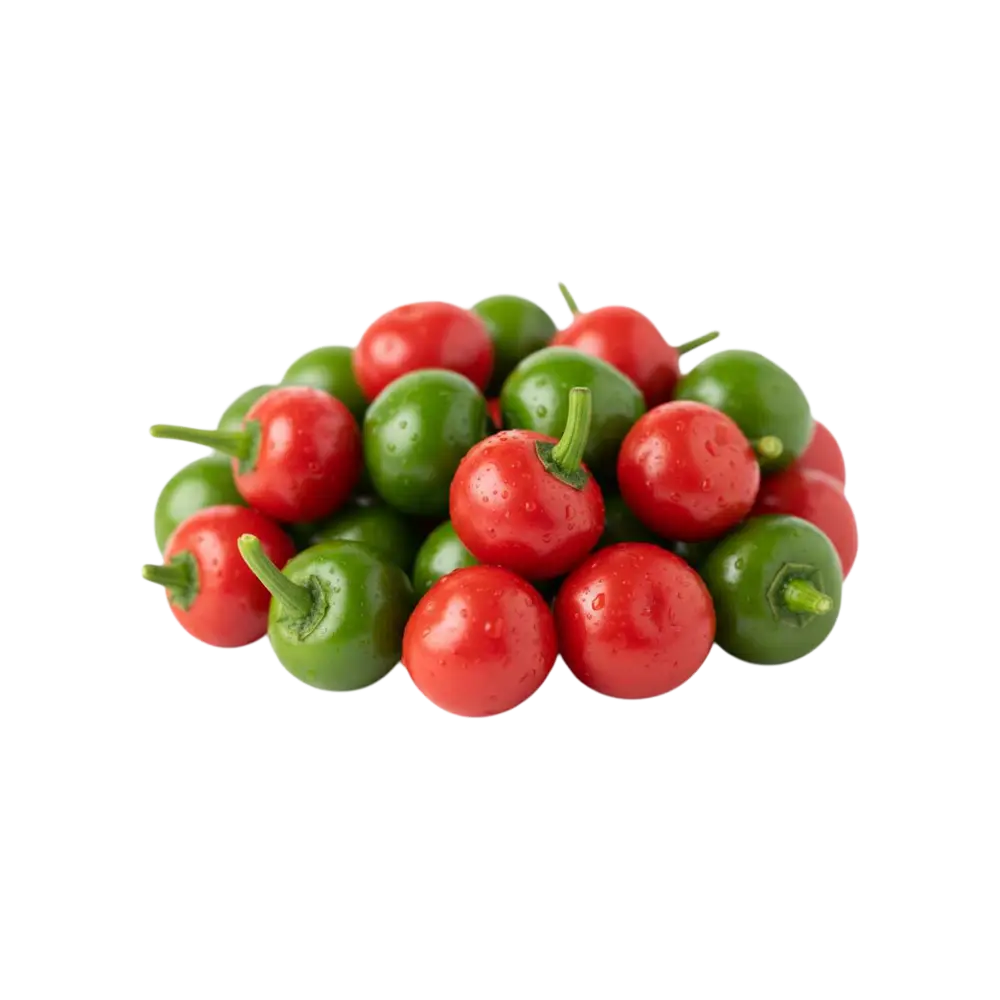
A small chilli with an outsized reputation
Dalle Khorsani belongs to the family Solanaceae, genus Capsicum — a round, cherry-sized fruit that ripens to a bright, glossy red. Its scale of pungency and its list of traditional health associations are what first set it apart at the haat bazaar.
From a Namphok kitchen garden to a global trademark
The crop was first grown commercially in Namphok, South Sikkim, by Mr. Nanda Lall Dawari in 1996, with roughly 600 saplings. It was later sold in the nearby Rabongla and Singtam haat bazaars — the start of a journey that carried Dalle Khorsani onto national and international shelves.
First commercial planting, Namphok
Mr. Nanda Lall Dawari raises around 600 saplings in South Sikkim and begins selling the fruit at Rabongla and Singtam haat bazaars.
First processing unit, Rabongla
Mr. Samir Tamhane starts processing Dalle into pickle and paste, launching it under the brand names Sikkim Supreme and High Altitude.
Government preservation factory, Singtam
A government food preservation unit in East Sikkim takes up production, and commercial cultivation expands among local farmers.
Sikkim Greengrocer, Lower Sichey
A new processing unit opens in Gangtok under the brand Sikkim Greengrocer, producing Dalle Khorsani pickle and paste for a wider market.
The “peero” sauce, and a trademark dispute
Greengrocer launches a Dalle-based hot sauce under the globally registered brand peero, opening national and international markets. The 180-year-old American company Tabasco raised a legal notice over product design — a dispute later resolved amicably.
Official recognition for Sikkim
Dalle Khorsani receives Geographical Indication status for Sikkim — a distinction the state's farmers regard with considerable pride.
How Dalle Khorsani is grown
A farmer's reference, drawn from Sikkim's extension practice — from nursery bed to harvest basket.
Climate & Land
Dalle prefers a warm, humid climate and tolerates heat well, but cannot withstand heavy rain during growth, flowering and fruit set. Cold below 12°C at night hampers growth; the ideal flowering range is 20–25°C. It adapts to a wide range of altitude and soil, though sandy loam at pH 5.7–7.5 is ideal — waterlogging and highly acidic soil are both detrimental and call for lime or dolomite correction.
The main field is ploughed 3–4 times for a fine tilth, with farmyard manure worked in during the last ploughing; cow urine can also be used in soil preparation.
Nursery & Transplanting
The nursery site should be elevated, sunny, close to a water source, well-drained, and partially shaded under a protected structure. Beds are prepared with FYM (7 kg/m²), neem cake (2 kg/m²) and vermicompost (1 kg/m²), sized around 1m × 1m with paths for intercultural work. Mulching with dry leaves or black polythene aids germination; damping-off is managed with a Trichoderma / Pseudomonas culture drench and, in severe cases, Ridomil or Matco.
Seedlings are ready to transplant at 30–35 days. They're best hardened in open conditions a day before, and transplanted in the afternoon into a raised bed spaced 1m × 1m.
Nutrient Schedule
The recommended manures and bio-fertilisers for Dalle Khorsani, applied through organic sources for both root and foliar uptake:
| Source | Dose | Application | Time |
|---|---|---|---|
| FYM | 20 t/ha (2 kg/plant) | Soil | 15 days before planting |
| Neem Cake | 2 t/ha (20 g/plant) | Soil | 7 days before planting |
| Azospirillum + PSB | 20% (200 g/L), 15-min root dip | Seedling treatment | At planting |
| Vermicompost | 2.5 t/ha (250 g/plant) | Soil | 20 days after planting |
| Bio NPK | 0.3% (3 mL/L) | Foliar spray | 30 days after planting |
| Boron (Multiplex) | 0.2% (2 g/L) | Foliar spray | 30 days after planting |
| Miraculan | 0.05% (0.5 mL/plant) | Foliar spray | 20 & 40 days after planting |
| Cow Urine | 20% (urine : water 1:4) | Soil drench | Every 20 days |
Water, Mulch & Training
A continuous, moderate water supply is essential — the first irrigation follows transplanting immediately, then a weekly interval. Heavy irrigation is avoided, as standing water invites soil-borne wilt and collar rot. Dry leaves, paddy straw and saw dust all work as mulch, though black polythene sheet is considered the most effective for this crop.
Buds are pinched from the first and second nodes to boost vegetative growth, fruit set and yield, and unproductive first-node branches are clipped, especially in cooler weather when sunscald isn't a risk. Being a tall grower, Dalle needs staking to prevent lodging under fruit weight, with earthing-up done 30–45 days after planting.
Plant Protection
Aphids (Aphis gossypii and Myzus persicae), locally called Lye Kira, are the main pest — sapping vigour, secreting honeydew that fosters sooty mould, and spreading viral disease. A systemic biopesticide, such as a Verticillium lecanii-based petroleum oil spray at 6 mL/L, is the standard response.
Fruit fly is the other major threat: eggs laid in the fruit hatch into maggots that feed from within, causing fruit drop. Growers manage it with 8–12 pheromone traps per acre at fruit-set time, alongside prompt collection and destruction of dropped fruit.
Harvest & After
Flowering begins 70–80 days after planting, with the first picking at the ripening stage; a healthy plant continues to bear fruit for two to three years. Fruits are lifted gently by hand to avoid injuring the plant or breaking the stem.
Dalle is a sensitive crop once picked — it must be processed within a week of harvest. Left to dry in the sun, it's ground into chilli powder instead.
What goes into the jar
Nutrition & traditional benefits
- Vitamin A stays remarkably stable through drying, so both paprika and dried Dalle retain a high share of it.
- Vitamin C, by contrast, is sensitive to heat and drying — best preserved when the fruit is used fresh.
- Capsaicin, carotenoids & phenolic compounds give Dalle its colour, its heat, and much of its antioxidant character.
- Herbalists have long credited pepper with clearing the lungs and sinuses and promoting the flow of digestive juices.
- Its heat is said to trigger endorphin release — a natural pain reliever — while the saliva it induces helps neutralise cavity-causing acids.
From field to shelf
Fully ripened, bright red pods go into pickles, pastes, sauces and chilli flakes. Dalle's commercial journey has produced a cluster of homegrown brands, and even drawn the interest of Patanjali, which has launched its own Dalle-based pickle and sauce line.
Peero Healthcare Pvt. Ltd.
The company behind the peero brand began as a small food-processing unit in Gangtok, and has since carried Dalle Khorsani — and Sikkim's growing traditions — well beyond the state's borders.
Registered in Uttarakhand for food processing, farming and consultancy, the company's first venture was a small unit at Lower Sichey, Gangtok, launched with Dalle, bamboo shoot and mushroom pickles. The range has since grown to sauces, chilli flakes, mixed and mango pickles, sold alongside fresh produce from Sikkimese growers through its retail arm, M/S Greengrocer, at Kangchenjunga Shopping Complex.
In 2017, a collaboration with Acharya Balkrishna (CEO, Patanjali) allotted the company over 300 acres at Bari Pokhri, Rishikesh, for a Himalayan model farm — carrying cardamom from Tashiding, oranges from Dzongu, Thai lemons and sandalwood into Uttarakhand. Dalle Khorsani was planted there the same year; the first season alone yielded 25 tonnes. Today the Bari Pokhri farm produces over 200 MT of lemons a year, alongside maturing sandalwood and Himachal apple varieties.
- Registered10 Mar 2017
- Registration No.U15123UR2017PTC007658
- First unitLower Sichey, Gangtok
- Farm area, Bari Pokhri300+ acres
- First Dalle harvest25 tonnes
- Lemon output200+ MT/yr